What Is the Difference Between Nursery, Pre-Nursery and Playschool?
Three terms, three different stages of readiness — and almost no agreement between schools on what to call them. Here’s what actually separates one from the next.
If you’ve started looking into early education in Doha, you’ve probably run into something confusing: every school seems to use these words a little differently. One nursery calls its youngest class “playschool.” Another uses the same name for two-year-olds that a different school reserves for four-year-olds. A third skips “pre-nursery” altogether and goes straight from playgroup to nursery. It’s not you — these terms were never standardized the way “Grade 1” or “Grade 2” are, and they shift from country to country, and even school to school within the same city.
The good news is that once you understand what actually happens at each stage, rather than just the label on the door, picking the right fit for your child gets a lot easier. This guide walks through nursery, pre-nursery, and playschool one comparison at a time, so you know exactly what to ask when you’re touring schools in Doha or filling out an application form. If you’d like to see how this plays out in practice, our Classes page breaks down what a typical day looks like in KG-01 and KG-02.
A Rough Ladder, Not a Rulebook
Where each stage sits, from least structured to most
Most early years programs sit somewhere along this progression:
Nursery vs. Pre-Nursery
Why this comparison confuses parents most
This is usually the comparison that confuses parents most, because the two stages sit right next to each other and the age gap between them can be as small as six months.
Pre-nursery is typically for children between about two and a half and three and a half years old. At this stage, a child is still learning basic things most adults take for granted — how to sit through a short group activity, how to follow one instruction at a time, how to be somewhere without a parent for a couple of hours. The day is loosely built around circle time, storytelling, art, and free play. There’s no real curriculum yet. If your child still needs help with toileting or gets overwhelmed in a room of unfamiliar faces, pre-nursery is designed with exactly that in mind.
Nursery, usually for children around three to four years old, is where things get noticeably more organized. There’s still plenty of play, but it now has direction: letter and sound recognition, counting, shape and color concepts, and group activities that ask children to cooperate rather than just coexist. Teachers start tracking developmental milestones more formally, and the daily schedule starts to resemble a real school day, with defined blocks for different activities.
| Pre-Nursery | Nursery | |
|---|---|---|
| Typical age | 2.5–3.5 years | 3–4 years |
| Main focus | Comfort, independence, simple routines | Early literacy, numbers, group cooperation |
| Structure | Very light, mostly free play | Defined schedule, some guided activities |
| Typical goal | Ease of separation, basic self-help skills | Readiness for a more formal classroom |
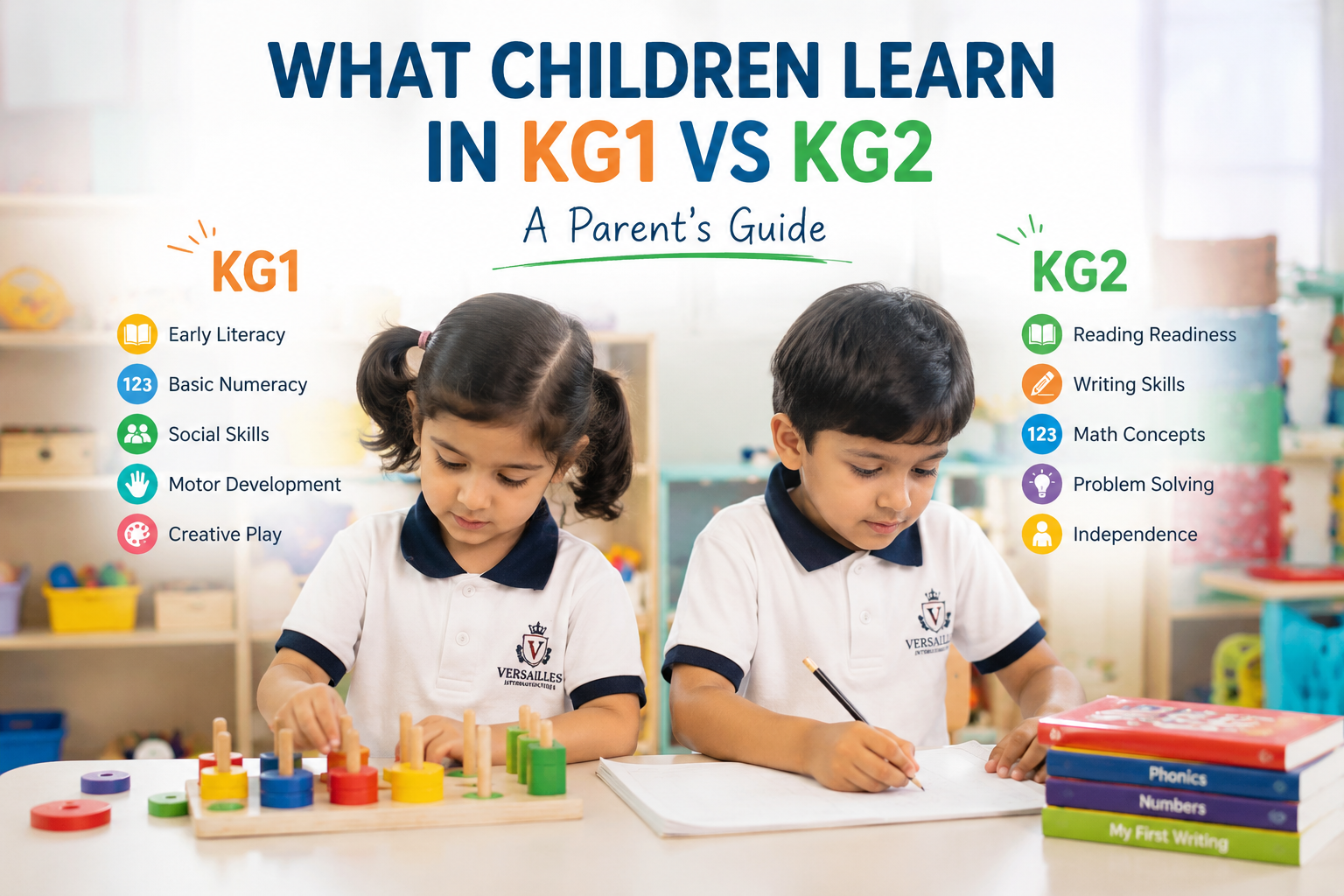
If your child has already spent time in a playgroup or has older siblings and is used to being around other children, you can often skip pre-nursery and start directly in nursery. If this is their first time away from home in any structured setting, pre-nursery gives them a gentler runway. Our post on what children actually learn in KG1 versus KG2 covers what comes after this stage, if you’re planning further ahead.
Pre-Nursery vs. Playschool
The earliest step on the ladder
This comparison sits a step earlier, and it’s really about how much “school” belongs in a program at all.
Playschool — sometimes called playgroup — is the least structured stage, generally for children from about eighteen months to three years old. The entire point is exposure, not education in any formal sense. Sessions are usually short, two to three hours at most, and built entirely around supervised play: sensory activities, rhymes, puppet shows, simple movement games. There’s no expectation that a child sits still, follows instructions in sequence, or interacts with a curriculum of any kind.
Pre-nursery keeps a lot of that same playfulness but starts introducing very light routine. Children are expected to sit for a few minutes at a time, follow a single-step instruction, and take part in group moments like circle time. It’s still gentle, but it’s the first hint of a “day” rather than just a “session.”
| Playschool | Pre-Nursery | |
|---|---|---|
| Typical age | 18 months – 3 years | 2.5–3.5 years |
| Session length | 2–3 hours, informal | Slightly longer, semi-structured |
| Main focus | Social exposure, sensory play | Independence, simple routines |
| Expectations of child | None — free play throughout | Sit briefly, follow one instruction |
A good way to tell which one your child needs: if they’re still napping twice a day, aren’t talking in short sentences yet, or get visibly distressed by new environments, playschool is the better starting point. If they’re already chatting, curious about other kids, and can handle a couple of hours without you nearby, pre-nursery is a reasonable place to begin. Our guide to preparing your child for the first day of school has practical tips that apply just as well to this earlier stage.
Nursery vs. Playschool
Can you skip a stage entirely?
This is the widest gap of the three, so it’s worth spelling out clearly, since some parents wonder whether they can skip straight from playschool to nursery without anything in between.
Playschool, as covered above, is built around free play and social comfort for toddlers roughly eighteen months to three years old. There’s no academic content, no fixed curriculum, and very little expectation placed on the child beyond simply being present and engaged. Nursery, for children roughly three to four years old, introduces real academic groundwork: recognizing letters and numbers, following multi-step instructions, working in small groups toward a shared task, and building the kind of classroom habits — sitting for a story, raising a hand, waiting a turn — that preschool and kindergarten will build on directly.
| Playschool | Nursery | |
|---|---|---|
| Typical age | 18 months – 3 years | 3–4 years |
| Curriculum | None | Early literacy and numeracy basics |
| Daily structure | Free play, short sessions | Scheduled blocks, guided activities |
| Social expectations | Parallel play is normal | Cooperative play, sharing, turn-taking |
| Best for | First time away from home | Children ready for early learning goals |
Can a child go straight from home to nursery, skipping playschool entirely? Often, yes — plenty of children do this without any issue, especially if they’ve had regular playdates, have older siblings, or are naturally sociable. What matters more than the label is whether your child can manage a few hours away from you without distress and follow at least a basic instruction. If you’re unsure, our article on what actually makes a preschool program work well is a useful read before you commit to any one path.
How to Decide What’s Right for Your Child
Two questions to ask yourself, and four to ask any school
Age is a starting point, not the whole answer. Two three-year-olds can be at very different stages of readiness, and a good school will tell you that honestly rather than pushing every child into the same class because of their birth year.
- ✦SeparationCan my child manage two to three hours away from me without becoming distressed?
- ✦InstructionsDo they follow a simple one-step instruction most of the time?
- ✦Social interestAre they curious about other children, or do they still mostly play alone?
- ✦Early curiosityDo they show any interest in letters, numbers, or being “taught” something?
And a few questions worth asking any school directly, regardless of what they call their youngest class:
- What does a typical day actually look like, hour by hour?
- How much of the day is free play versus guided activity?
- What skills do you expect a child to have by the end of the year?
- How do teachers handle separation anxiety in the first few weeks?
If you want a longer checklist for evaluating kindergartens specifically, our parent’s guide to choosing a kindergarten in Doha walks through everything from curriculum to class size. And if you’ve already decided Versailles might be the right fit, our how-to-choose page compares our British and French curriculum tracks so you can pick the one that suits your family.
One last thing worth saying plainly: these labels genuinely differ by country, and sometimes by individual school even within the same city. What one nursery in Doha calls “pre-nursery,” another might call “playgroup,” and a third might not offer that stage at all. The age ranges in this guide are a solid general reference, but they’re not a fixed rule. When you’re evaluating a specific school, the label on the class matters far less than what actually happens inside it. Ask directly — a good school will walk you through their daily schedule without hesitation, and that conversation will tell you more than any brochure.
Thinking about Versailles for your child?
We’d be glad to show you around and talk through what stage fits best for your family.