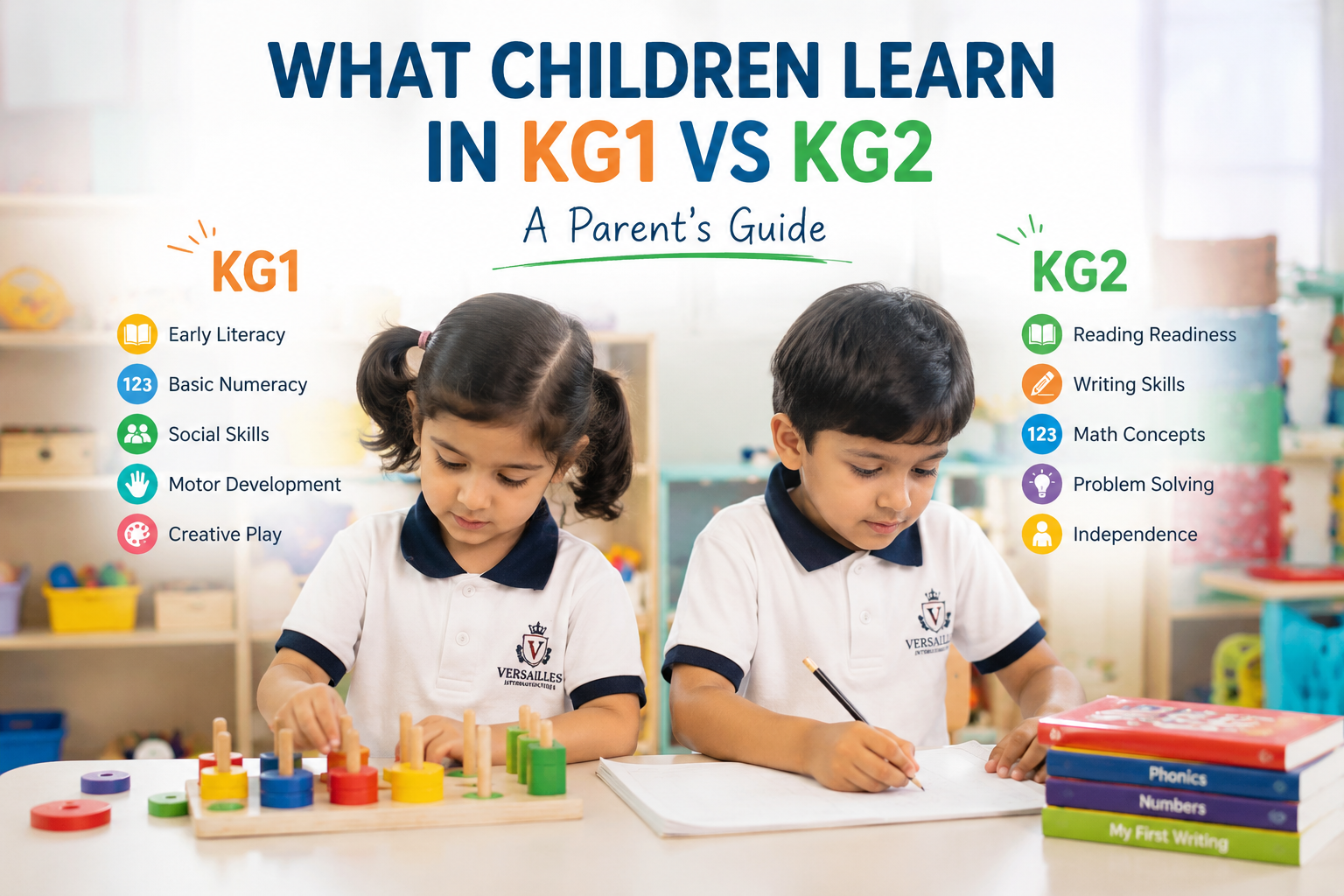
For many parents, the kindergarten years are filled with excitement, curiosity, and important decisions. One common question families ask is: What is the difference between KG1 and KG2? Understanding what children learn at each stage can help parents choose the right educational environment and support their child’s development at home.
Kindergarten is much more than learning letters and numbers. It is a crucial period when children develop social skills, emotional confidence, communication abilities, creativity, and independence. Each year builds upon the previous one, creating a strong foundation for lifelong learning.
At Versailles International Kindergarten, children are guided through age-appropriate learning experiences that nurture their academic, social, emotional, and physical development. While KG1 focuses on exploration and foundational skills, KG2 prepares children for the increased responsibilities and expectations of primary school.
In this guide, we will explore what children typically learn in KG1 and KG2, the key differences between the two stages, and how parents can support their child’s learning journey.
Understanding Kindergarten Stages in Qatar
Kindergarten education is designed to support children during their most important developmental years. In most international and private schools across Qatar, kindergarten is divided into two stages:
- KG1: Usually for children aged 3 to 4 years.
- KG2: Usually for children aged 4 to 5 years.
Although these age ranges may vary slightly depending on school requirements, the overall objective remains the same: helping children develop the skills and confidence needed for future academic success.
Each stage is carefully structured to match children’s developmental readiness. Rather than focusing solely on academics, kindergarten programs encourage curiosity, creativity, communication, and positive social interactions.
Parents searching for the best kindergarten in Al Markhiya often look for programs that provide a smooth progression from KG1 to KG2 while supporting every aspect of a child’s growth.
What Children Learn in KG1
KG1 serves as a child’s introduction to formal learning. For many children, it is their first experience spending significant time away from home in a structured environment.
The primary goal of KG1 is to help children feel comfortable, confident, and excited about learning.
Language and Communication Development
Communication skills are among the most important areas of focus during KG1. Children are encouraged to express their thoughts, listen to others, and participate in conversations.
Common language development activities include:
- Learning new vocabulary words
- Listening to stories
- Singing songs and rhymes
- Participating in group discussions
- Following simple instructions
These experiences help children build confidence in expressing themselves while developing strong listening skills.
Early Literacy Skills
KG1 introduces children to the foundations of reading and writing. Learning is presented through engaging and interactive activities rather than formal instruction.
Children begin to:
- Recognize letters of the alphabet
- Identify letter sounds
- Understand that print carries meaning
- Develop an interest in books and storytelling
- Practice pencil control and pre-writing skills
These foundational experiences prepare children for more advanced literacy development in KG2.
Early Mathematics Concepts
Mathematics in KG1 focuses on building basic number awareness and logical thinking.
Children explore:
- Number recognition
- Counting objects
- Sorting and matching activities
- Recognizing shapes
- Understanding simple patterns
- Comparing sizes and quantities
Learning takes place through games, hands-on materials, and everyday classroom activities.
Social and Emotional Development
One of the most significant aspects of KG1 is learning how to interact positively with others.
Children practice:
- Sharing and taking turns
- Cooperating with classmates
- Managing emotions
- Building friendships
- Following classroom routines
Developing these social skills helps children become more confident and independent learners.
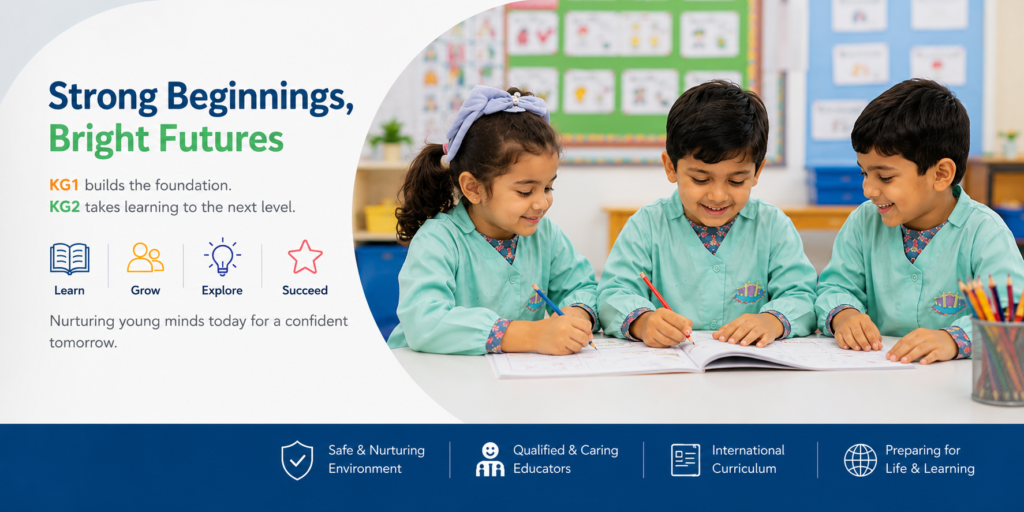
Physical Development
Physical activities play an important role in kindergarten education.
Children strengthen:
- Fine motor skills through drawing, cutting, and crafts
- Hand-eye coordination
- Balance and movement
- Gross motor skills through outdoor play and physical activities
Strong motor development supports future writing, sports participation, and everyday tasks.
What Children Learn in KG2
By the time children enter KG2, they are generally more comfortable with classroom routines and expectations. As a result, learning becomes more structured while still maintaining a playful and engaging approach.
KG2 focuses on strengthening the skills introduced in KG1 while preparing children for the transition to primary school.
Reading Readiness
Literacy development becomes more advanced in KG2.
Children often begin to:
- Recognize common sight words
- Blend letter sounds together
- Read simple words and sentences
- Improve listening comprehension
- Retell stories in sequence
These experiences help children build confidence as emerging readers.
Writing Development
Children continue developing writing skills by:
- Writing letters correctly
- Practicing name writing
- Forming simple words
- Drawing and labeling pictures
- Beginning sentence construction
Writing activities help children communicate their ideas while improving fine motor control.
Mathematical Thinking
KG2 introduces more advanced mathematical concepts that support future classroom learning.
Children may learn:
- Number sequencing
- Simple addition and subtraction concepts
- Measurement basics
- Comparing numbers
- Problem-solving strategies
- Recognizing patterns and relationships
Hands-on learning remains central to helping children understand mathematical ideas.
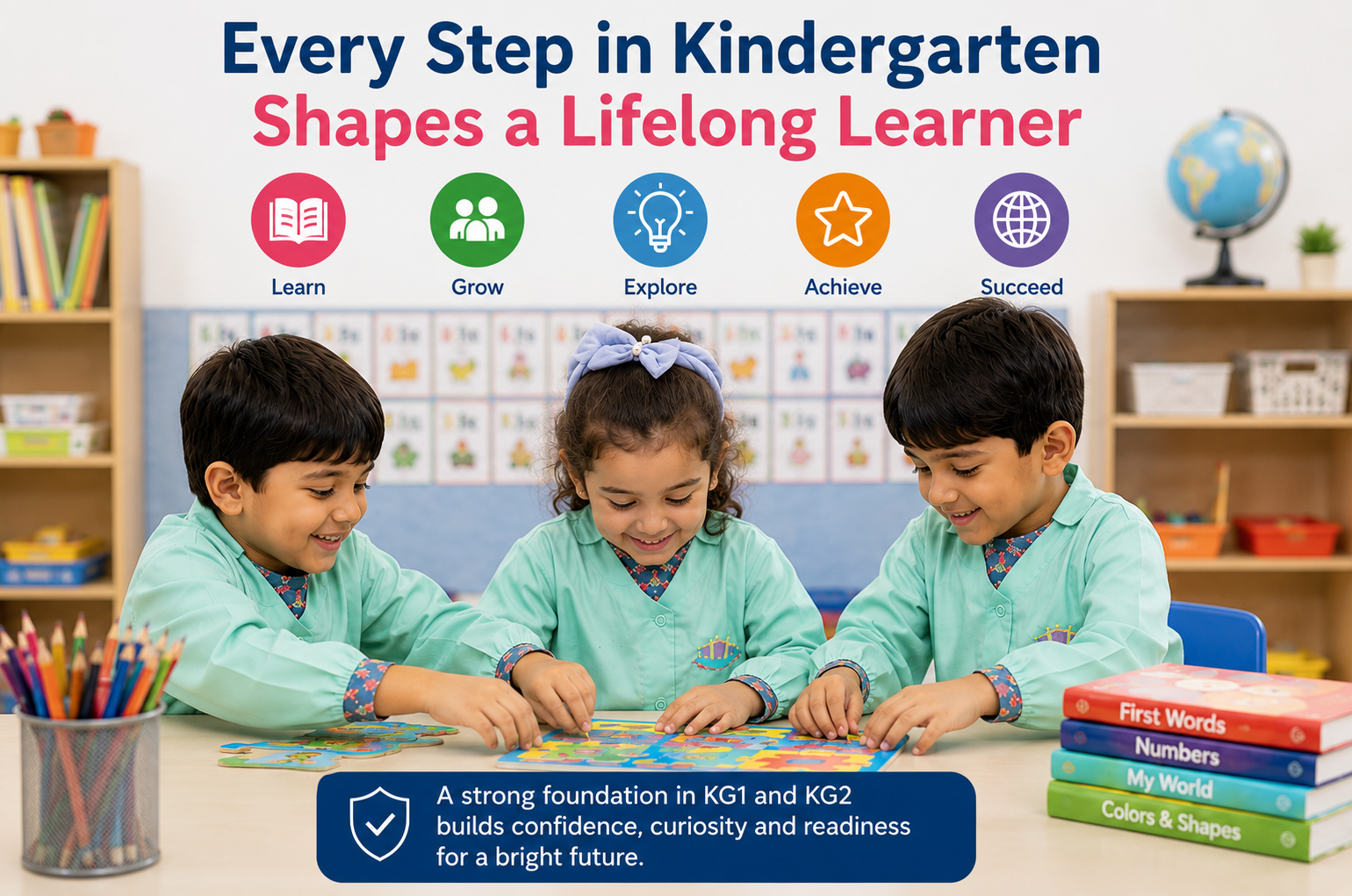
Critical Thinking and Inquiry Skills
KG2 encourages children to think independently and explore solutions.
Activities often involve:
- Asking questions
- Making predictions
- Investigating new concepts
- Solving simple problems
- Participating in collaborative projects
These skills promote curiosity and confidence in learning.
Greater Independence
One of the key goals of KG2 is helping children become more self-reliant.
Children learn to:
- Manage personal belongings
- Complete tasks independently
- Follow multi-step instructions
- Take responsibility for classroom routines
- Demonstrate self-confidence in new situations
These skills contribute significantly to school readiness.
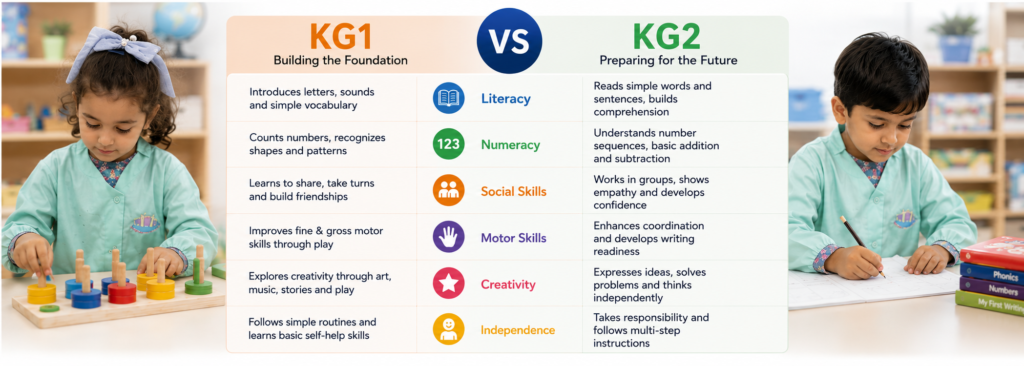
Key Differences Between KG1 and KG2
Although both stages focus on child-centered learning, there are important differences between KG1 and KG2.
| KG1 | KG2 |
|---|---|
| Focuses on exploration and discovery | Focuses on school readiness |
| Introduces basic literacy concepts | Develops reading and writing skills |
| Builds foundational number awareness | Introduces simple mathematical operations |
| Encourages social interaction | Strengthens independence and responsibility |
| Learning through guided play | Learning through structured activities and play |
Rather than viewing KG1 and KG2 as separate stages, it is helpful to see them as part of a continuous learning journey that gradually prepares children for future academic success.
How Parents Can Support Learning at Home
Parents play a valuable role in reinforcing classroom learning. Simple daily activities can strengthen the skills children develop in kindergarten.
Consider these strategies:
- Read together every day.
- Encourage conversations and storytelling.
- Practice counting during daily activities.
- Provide opportunities for creative play.
- Praise effort and persistence.
- Establish consistent routines.
- Encourage independence with age-appropriate tasks.
Small, consistent interactions at home can make a significant difference in a child’s confidence and learning progress.
Why a Strong KG1 and KG2 Journey Matters
The skills children develop during kindergarten extend far beyond academics. Research consistently shows that high-quality early childhood education contributes to better long-term educational outcomes, stronger social skills, and greater self-confidence.
Families looking for the best kindergarten in Doha often prioritize programs that provide a balanced approach to learning while supporting children’s emotional and social development.
When children experience a well-structured progression through KG1 and KG2, they are better prepared to:
- Adapt to primary school expectations
- Develop positive learning habits
- Communicate effectively
- Work collaboratively with others
- Approach challenges with confidence
Conclusion
Both KG1 and KG2 play an essential role in shaping a child’s educational journey. KG1 introduces children to the joys of learning, helping them develop foundational academic and social skills through exploration and play. KG2 builds upon these foundations, preparing children for the increased responsibilities and academic expectations of primary school.
At Versailles International Kindergarten, children are supported through every stage of their early learning journey with a nurturing, engaging, and developmentally appropriate curriculum. By understanding what children learn in KG1 and KG2, parents can better support their child’s growth and ensure they are well-prepared for future success.