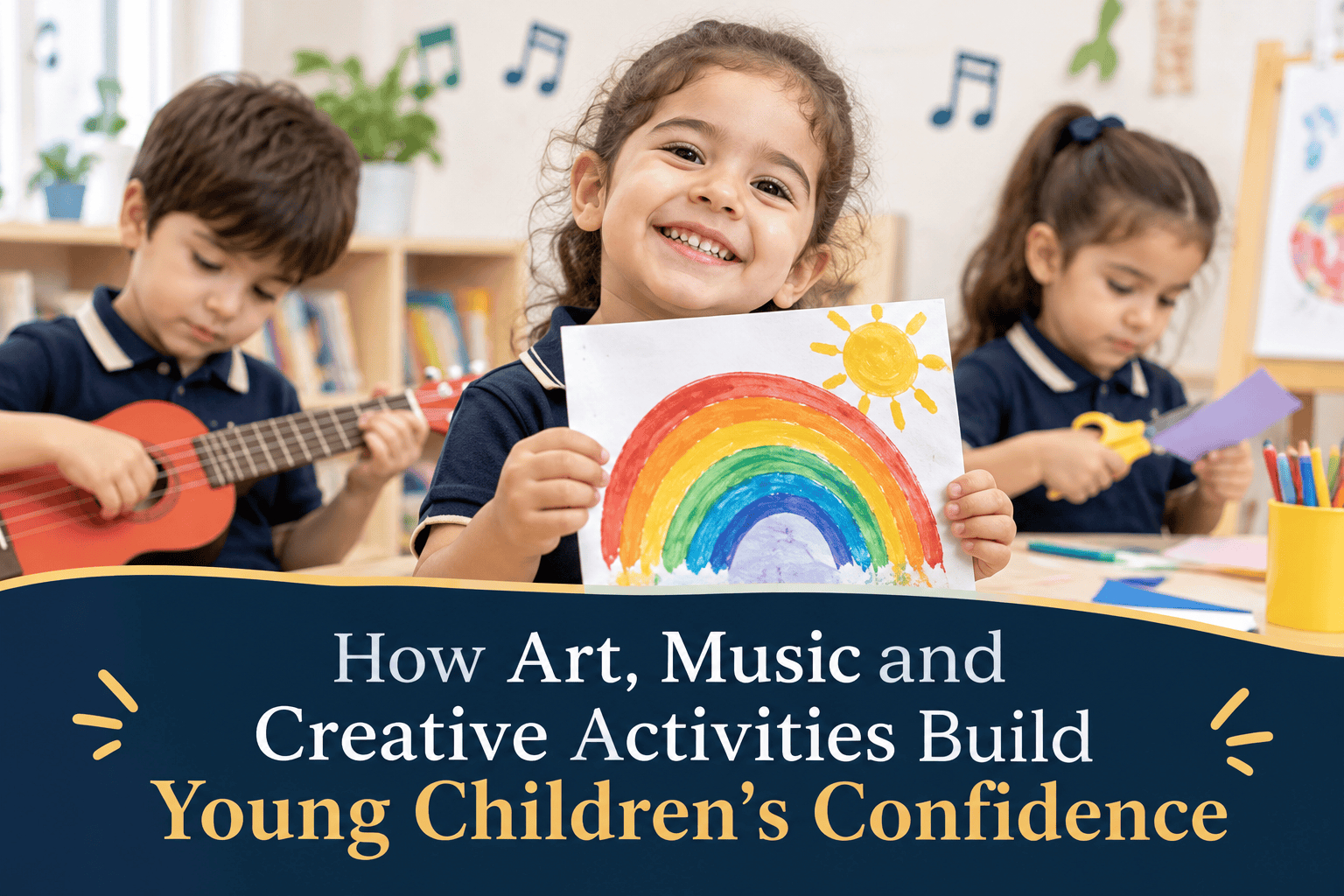
A practical guide for parents and teachers on how art, music, drama and movement help young children feel capable, try new things and share their ideas.
Posted on | 7 min read | Early childhood development
Quick answer: Art, music, drama and movement build young children's confidence by giving them safe opportunities to make choices, try new things, make mistakes and see their own ideas valued. When a child repeatedly experiences "I made that" and "I can do that," they develop a strong sense of capability. Regular creative activities for kindergarten children also strengthen communication, emotional regulation and resilience, which are the foundations of lasting self-belief.
Introduction
Walk into a lively kindergarten classroom and you may see a child holding up a painting with a proud grin while a small group sings a counting song nearby. These moments look like play, yet they do serious developmental work. They show children, through experience rather than compliments, that they can start something, struggle a little and finish it.
Families searching for the Best Kindergarten in Doha often ask how a school nurtures belief in oneself alongside academic readiness. This article explains how art, music, drama and movement build that belief, and how teachers and parents can support it.
What does confidence look like in a young child?
Early confidence is a child's sense that they are capable, that their ideas matter and that it is safe to try. Psychologists call the underlying belief self-efficacy: "my actions can make things happen." It rarely looks like loudness. Watch instead for a child who tries an unfamiliar task, asks for help without embarrassment, recovers calmly when something goes wrong and feels comfortable doing things differently from friends.
These behaviours are learned through repeated, low-pressure chances to take small risks. Creative work supplies those chances for four reasons:
- There is no single right answer. Nobody can fail at painting a purple sun, so fear of being wrong fades.
- Children make real choices about colours, instruments and characters, which gives them a sense of control.
- The results are visible. A drawing on the wall or a song performed for friends is tangible proof of ability.
- Feelings find an outlet. Creative work helps children name emotions, which eases frustration and builds security.
How does art build confidence?
Art is often a child's first experience of authorship. Every mark on the page is theirs, and several confidence-building processes happen at once.
Ownership. Deciding what to create and how tells a child, "Your ideas are worth pursuing."
Visible skill growth. Holding a brush, cutting with scissors and moulding clay are demanding. Each small improvement is concrete evidence that "I am getting better."
Resilience. Paint drips and clay towers collapse. Children discover that setbacks can be fixed, reused or even celebrated, a habit that later helps with reading, writing and mathematics.
A voice for quiet children. Shy children, and those still learning the language of instruction, can express complex feelings through drawing before they have the words.
Being seen. When work is mounted or shared at a classroom exhibition, children experience recognition for their ideas, not only their results.
How does music build confidence?
Music combines emotion, rhythm, language and social connection, which makes it uniquely powerful at this age.
Group singing builds courage. Hesitant children can take part without being singled out. Over time, many volunteer a solo verse.
A steady beat is an achievable goal. Clapping a pattern or playing a drum gives instant, audible success.
Songs prove memory. Learning a full song, with its vocabulary and sequence, is a real accomplishment that reinforces "I can learn."
Belonging. Moving and singing together synchronises attention and emotion, strengthening empathy and friendship.
Performing builds composure. A seasonal song or small class concert teaches children to manage nerves, wait their turn and enjoy applause, a gentle rehearsal for later public speaking.
How do drama, movement and storytelling help?
- Role play lets children try new voices and practise social situations safely, building communication skills.
- Dance and movement develop body awareness; children who feel capable physically often approach new challenges more boldly.
- Puppetry and storytelling teach children to organise ideas and discover that an audience will listen to them.
Why does the process matter more than the product?
If adults care only whether a painting "looks right," children learn to seek approval instead of trusting their own judgement. Process-focused practice looks like this:
- Offer open-ended materials rather than templates or colouring-in sheets.
- Ask "Tell me about your picture" instead of "What is it?"
- Name effort and strategy: "You mixed three blues to get that shade."
- Let children leave work unfinished or change direction.
- Avoid comparing one child's work with another's.
Child-development research consistently finds that children praised for effort and persistence take on challenges more willingly than those praised for being "talented." Specific, effort-focused feedback is the simplest way to turn any creative moment into confidence.
How can parents support creativity at home?
- Set up a creativity corner with paper, crayons, chalk, glue and recycled materials within your child's reach.
- Make together. Sit beside your child and create something of your own, showing that enjoyment matters more than perfection.
- Display their work. A fridge gallery says that what they make is worth looking at.
- Add music to routines. Sing in the car, dance in the kitchen, clap rhythms at bedtime.
- Let your child lead. Resist fixing their work, even when it looks unusual, and use the effort-focused language described above.
For a practical guide to the first morning, read how to prepare your child for the first day of school.
How can you track creative confidence over a term?
Confidence grows slowly, so it helps to keep simple evidence rather than rely on impressions. Teachers and parents can build a small portfolio for each child: a dated drawing every few weeks, a short audio clip of a song, or a photo of a collage in progress. Beside each item, note one line in the child's own words, such as "I mixed the orange myself."
At the end of a term, lay the pieces out in order. Look for changes in the child's willingness to start, the range of materials they choose and the way they describe their work. These patterns reveal more than any single finished piece and give parents specific, encouraging points to discuss with teachers.
How does Versailles International Kindergarten nurture creative confidence?
Versailles International Kindergarten in Hazm El Markhia, Doha, says it is the first kindergarten in Qatar to offer the British EYFS curriculum and the French curriculum in parallel, so families can choose the pathway that suits their child. Its approach to creative activities for kindergarten children blends play, discovery and structured learning in a safe, joyful setting. Teachers guide children through play-based learning, with age-appropriate lesson plans designed to build confidence and social skills.
- KG-1 (ages 3–4) builds foundations through play, music, art and hands-on discovery.
- KG-2 (ages 4–5) prepares children for school with activities in literacy, numeracy and creative thinking.
- Dedicated spaces include a bright indoor playing area, a spacious outdoor area for exploring nature and a cosy reading corner.
To see these spaces in use, browse the school photo gallery or read about the kindergarten classes, then arrange a visit.
What does a confidence-building moment look like in practice?
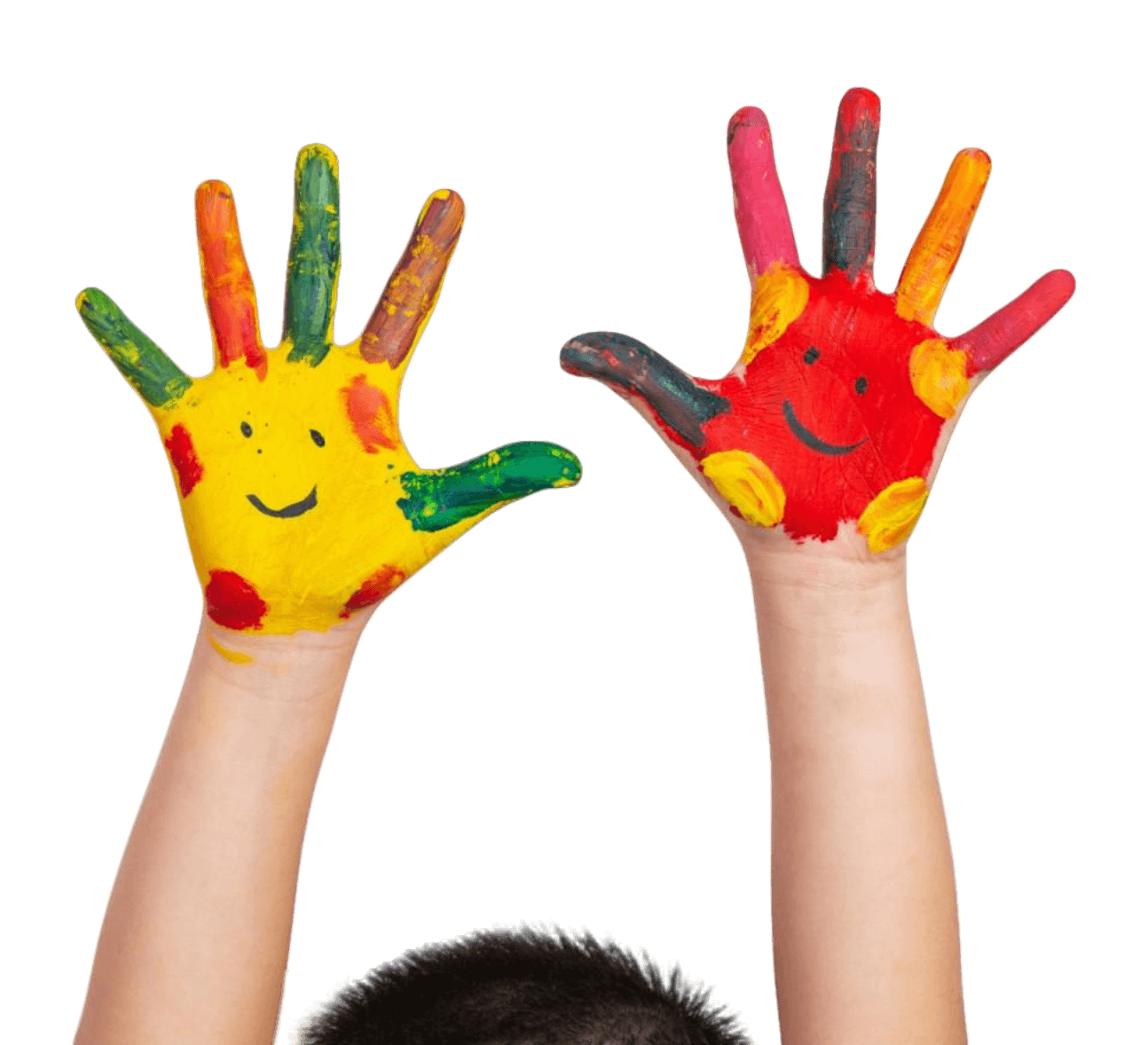
Imagine a four-year-old who always says "I can't" when handed a pencil. In a creative classroom, her teacher skips the pencil and offers a tray of finger paint. She smears blue across the page, notices the swirl her hand made and announces it is a wave. The teacher asks, "How did you make the wave move?" and the child demonstrates, wiggling her fingers.
Nothing was corrected and nothing was graded, yet the child has explained her thinking, practised a technique and received genuine interest in her idea. Repeated across weeks, small exchanges like this change the story a child tells herself, from "I can't" to "let me show you."
Frequently asked questions
At what age should children start art and music activities?
From infancy, through sensory exploration, singing and simple mark-making. By ages three to five, children are ready for open-ended painting, group songs and role play.
Do creative activities help academic learning?
Yes. Creative activities for kindergarten children support language development, fine motor control, memory and pattern recognition, which underpin early reading, writing and mathematics.
How much time should children spend on creative play each day?
There is no fixed rule, but daily opportunities are ideal. Many programmes include several short creative sessions, plus free play.
Can creativity help children learning in a second language?
Very much. Drawing, songs and puppets let multilingual children express ideas before their vocabulary catches up, which reduces anxiety and encourages speaking.
What if my child refuses to join in?
Invite rather than insist. Let them watch, offer a small role such as handing out materials, and try a quieter medium like clay or puppets. Most children join when pressure disappears.
Conclusion
Creativity is not an extra in early education. It is where children first discover that they are capable and that their ideas matter.
For families exploring the Best Kindergarten in Doha, the key question is not only what children will learn, but how they will feel while learning. Choose a place where effort is celebrated and every child's voice is heard. At Versailles International Kindergarten, daily activities are designed to spark curiosity and encourage creativity in every child.
Book a school visitLast updated: . This article is for general educational purposes and reflects widely accepted principles in early childhood development.