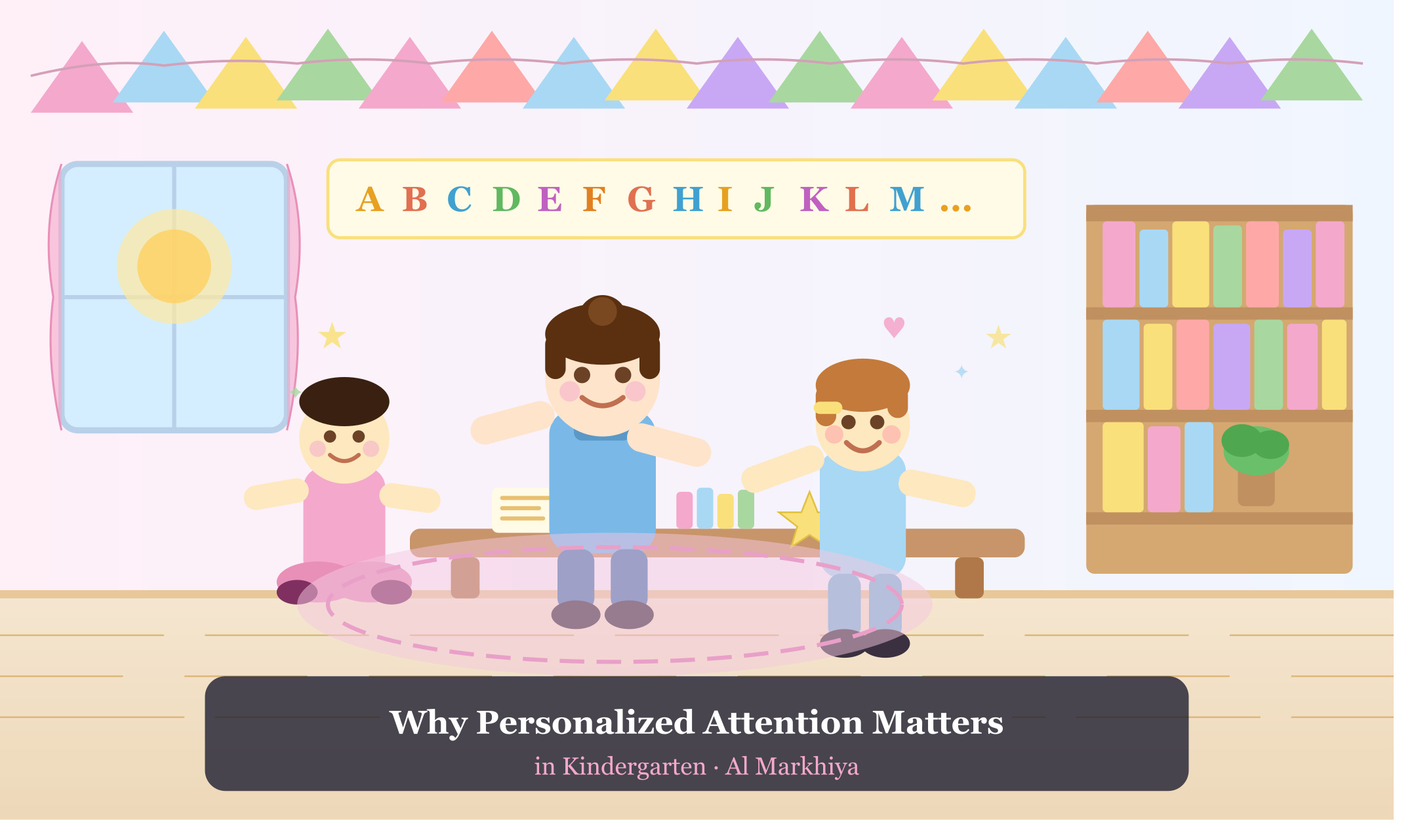
More Than a Teacher: Why Personalized Care Shapes Confident Kids
Every child is different — and the best kindergarten in Al Markhiya knows exactly what that means.
There's a moment every parent knows — that flicker of worry on the first day of school. Will someone notice if my child is struggling? Will the teacher see them — not just the class?
It's a completely natural feeling. And it's exactly why personalized attention isn't just a nice-to-have in early education. It's everything.
For families exploring early education in Al Markhiya, understanding what personalized learning really looks like — and why it matters so deeply at this stage — can make all the difference in finding the right fit.
Every Child Learns at Their Own Pace — And That's Beautiful
Think about the children in any kindergarten classroom. Some children are natural talkers — they're already stringing sentences together, asking questions, leading the conversation. Others are quiet observers, taking everything in before they feel ready to speak.
Neither of these children is ahead or behind. They're simply different.
A classroom that treats all five-year-olds as if they're at exactly the same stage can quietly discourage both groups — the chatty child who needs more challenge and the reserved child who needs more time.
When teachers at a top kindergarten in Al Markhiya adjust their approach for each child — slowing down for one, stretching another — children don't just learn faster. They learn better, because they're never lost and never bored.
- Children who learn at their natural pace build deeper understanding — not just surface-level memorization
- Being met where you are, rather than where you "should" be, prevents early frustration that can affect long-term attitudes toward school
- Individualized pacing means teachers catch small struggles early — before they snowball into bigger gaps
The Teacher–Child Relationship: Where the Real Magic Happens
Ask any adult about a teacher who changed their life — and chances are, they'll describe someone who noticed them. Not just their grades, but their personality, their struggles, their spark.
In kindergarten, this bond forms faster and runs deeper than at almost any other stage of education. Five-year-olds are exquisitely tuned to the adults around them. They read moods, they feel connection — and they respond to warmth in a way that older children sometimes won't let themselves.
A teacher who knows that Layla gets anxious before group activities, or that Ahmed lights up when talking about dinosaurs — that teacher can turn a potentially discouraging moment into one of encouragement. That's not just good teaching. That's a relationship.
Small class sizes make this possible
It's hard to build meaningful one-on-one connections when one teacher is responsible for thirty children. The best early education programs in Al Markhiya prioritize lower child-to-teacher ratios for exactly this reason — so no child disappears into the crowd.
- Teachers can identify learning preferences early (visual, auditory, hands-on) and adapt their methods accordingly
- Children who feel known by their teacher are far more likely to speak up when they don't understand something
- Strong early teacher-child bonds have been shown to have long-term positive effects on academic motivation
Emotional Development: The Foundation Beneath Every Lesson
Reading and counting matter in kindergarten, of course. But research consistently shows that children who feel emotionally secure learn academic skills more readily than those who don't.
A child who is anxious, lonely, or overwhelmed simply cannot absorb information well — no matter how good the curriculum is. Their little brains are too busy managing big feelings.
This is why the warmest kindergartens don't just teach letters and numbers — they teach children to name their feelings, manage frustration, work through disagreements, and celebrate other people's wins.
Personalized attention plays a huge role here. When a teacher notices that a child has arrived in a difficult mood and takes two minutes to sit with them before the day begins, that child is far more likely to engage positively with the whole morning.
For families searching for a kindergarten near me in the Al Markhiya area, asking about emotional support programs and social-emotional learning (SEL) frameworks is just as important as asking about literacy and numeracy — perhaps more so.
Building Confidence: The Greatest Gift of Early Education
Ask any kindergarten teacher what they most want for their students, and most will say the same thing: confidence.
Not perfect handwriting. Not the ability to count to one hundred. Not sitting still for thirty minutes. Confidence — the belief that "I can figure this out" — is what carries a child through primary school, secondary school, and far beyond.
Personalized attention is how that confidence gets built, one small win at a time. When a teacher breaks a task into steps that match exactly where a child is right now, that child experiences success. And success, at this age, is addictive in the best possible way.
Small wins daily
Each personalized success builds the "I can do it" mindset that fuels future learning
Voice & choice
Children who are heard learn to express ideas — a skill that serves them for life
Creative freedom
Personalized learning respects different strengths, including artistic and imaginative ones
Contrast this with a child who is constantly asked to perform tasks that are either too easy or too hard. Too easy, and boredom creeps in. Too hard, and shame follows. Either way, the message the child absorbs — even without words — is "school isn't for me."
The best kindergartens in Al Markhiya work hard to make sure every child leaves each day feeling capable and proud of what they did — not just what the class did collectively.
What to Look for When Choosing a Kindergarten Near You
Every family's priorities are different — location, curriculum, language of instruction, extra-curricular activities. But if personalized attention matters to you (and it should), here are a few practical questions worth exploring during any school visit:
- What is the child-to-teacher ratio? — A lower ratio means more time for each child. Look for no more than 15–18 children per qualified teacher in kindergarten settings
- How do teachers track individual progress? — Ask if there are regular assessments, portfolio systems, or parent communication tools that go beyond whole-class reporting
- How are children with different learning speeds supported? — The answer should not be "we move at the curriculum's pace." It should reflect genuine flexibility
- What role does social-emotional learning play in the day? — Circle time, conflict resolution strategies, and emotion vocabulary are good signs
- How often will I hear from my child's teacher? — Regular, specific feedback (not just reports twice a year) signals a school that takes the individual seriously
Whether you're actively comparing options or just beginning to explore early education in Al Markhiya, these questions can open up real, meaningful conversations with school staff — and give you a genuine sense of how a school thinks about your child as an individual.
A Final Thought for Every Parent
Your child doesn't need to be the fastest learner in the room. They don't need to shine above everyone else or hit every milestone on the chart's timeline.
What they need — at five years old — is someone who sees them. Who slows down to understand them. Who knows that behind every quiet moment or wobbling voice, there's a bright and curious mind doing its best.
That kind of care is the quiet hallmark of great early education — and it's worth looking for, asking about, and expecting as a standard, not a luxury.
Because every child deserves to feel like the best version of themselves — starting on day one. 🌟
Frequently Asked Questions
Everything parents want to know about kindergarten in Al Markhiya
What age should my child start kindergarten?
Most kindergartens in Al Markhiya welcome children between 4 and 6 years old. Many schools assess readiness not just by age but by social and emotional development — so a brief orientation visit is often offered before enrollment to ensure it's the right fit for your child.
How do I know if a kindergarten truly offers personalized learning?
Ask about child-to-teacher ratios (ideally 15 or fewer per teacher), whether teachers track individual progress through portfolios or observation notes, and how they handle children who are ahead of or behind the class pace. The honest answer should describe genuine flexibility — not just following the curriculum pace.
What is social-emotional learning (SEL) and why does it matter?
Social-emotional learning (SEL) helps children identify and manage emotions, develop empathy, build relationships, and make responsible decisions. Research shows children with strong SEL skills absorb academic content more readily and have better long-term outcomes — it is just as important as literacy and numeracy at this stage.
How often will teachers communicate with me about my child's progress?
The best kindergartens offer regular, specific communication — not just two formal reports per year. Look for schools that use parent apps, weekly updates, or informal check-ins. Meaningful feedback about your individual child (rather than whole-class updates) is a strong sign of genuine personalization.
What if my child is shy or takes longer to settle in?
A warm, experienced kindergarten team expects this and plans for it. Ask what the settling-in process looks like — good schools offer gradual start schedules, assign a key teacher to each child, and never rush the transition. A child who is given time to feel safe will thrive far more than one who is pushed too quickly.
Should I choose a kindergarten based on curriculum or environment?
Both matter, but environment comes first at this age. A child who feels safe, seen, and happy will absorb almost any well-designed curriculum. A child who is anxious or overwhelmed will struggle even with the best materials. Visit in person, observe how teachers speak to children, and trust what you feel during the visit.
Are bilingual or multilingual programs available in Al Markhiya?
Yes — several kindergartens in the Al Markhiya area offer bilingual instruction, typically in Arabic and English, with some schools offering additional language exposure. Early childhood is one of the best windows for language acquisition, so if multilingual learning is a priority, ask schools specifically about their language program structure and daily practice.
What extracurricular activities should a good kindergarten offer?
Look for a balance of creative, physical, and exploratory activities — art, music, movement, outdoor play, and storytelling are all developmentally appropriate and valuable. Be cautious of programs that prioritize academic drilling above play at this age; play-based learning is backed by decades of research as the most effective approach for children under six.