Why a Combined British & French Curriculum Is the Best Choice for Your Child in Qatar
The complete guide for parents in Doha navigating the most important educational decision of their child's early years — and why a bilingual foundation changes everything.
There is a moment every parent in Qatar knows well. The conversation turns — as it always does — to schools. And suddenly, you realise the question is not simply "which school?" but rather: "which world do I want my child to grow up ready for?"
Doha is unlike any other city on earth when it comes to raising children. In a single classroom, you might find a child from Lebanon sitting beside one from the UK, next to another from France, the Philippines, or Egypt. Qatar is a nation built on ambition, diversity, and global connection — and families here hold high expectations, not just for academic results, but for raising confident, multilingual, globally aware human beings.
That is the pressure you carry as a parent. And it is real. The years between three and five shape everything: the way your child thinks, communicates, and relates to the world around them. Choosing the wrong environment at this stage is not a small matter.
So what if you did not have to choose between the two most respected educational traditions in the world? What if your child could benefit from both — simultaneously — right here at the best kindergarten in Al Markhiya?
That is precisely the vision behind Versailles International Kindergarten. And in this guide, we want to walk you through exactly why this approach is not a compromise — it is an advantage.
Structure, Literacy, and a Love of Learning
How the EYFS framework builds your child's foundations with intention and joy
The British educational framework for early years is built on a foundation known as the EYFS — the Early Years Foundation Stage. Developed, refined, and mandated in the United Kingdom, it is widely regarded as one of the most thoughtfully designed early childhood frameworks in the world — and its influence has reached well beyond Britain's borders.
At its core, the EYFS is not about rote learning or sitting children at desks to memorise facts. It is about understanding how young children actually develop — physically, emotionally, socially, and intellectually — and designing an environment that meets them exactly where they are.
-
✦Personal, Social & Emotional DevelopmentTeaching children how to manage their feelings, build relationships, and develop independence — the invisible foundation of everything that follows.
-
✦Communication and LanguageEncouraging speaking, listening, and the ability to express ideas clearly — skills that shape every relationship your child will ever have.
-
✦LiteracyThe foundations of reading and writing, introduced through phonics, storytelling, and rich language environments that make words feel like gifts.
-
✦MathematicsNumber sense, shape, pattern, and early problem-solving — not through worksheets, but through play and hands-on discovery.
-
✦Understanding the WorldExploring nature, technology, people, and communities — building the curiosity that drives lifelong learning.
-
✦Expressive Arts and DesignMusic, movement, drawing, and creative play — giving children the vocabulary to express what words cannot yet capture.
What makes EYFS so powerful is its balance. It provides clear, measurable milestones — so you always know where your child stands. But it delivers those milestones through play-based, child-led learning that keeps children genuinely engaged and joyful. The British system also cultivates a growth mindset — the belief that effort leads to improvement. Children are encouraged to try, ask questions, be curious, and persist. These are not soft skills. They are the foundations of every successful adult.
Creative Thinking, Analytical Depth & the Prestige of French
Why the French approach cultivates the thinking mind from the very first years
If the British system provides structure and literacy scaffolding, the French educational philosophy brings something equally invaluable: a deep, almost philosophical commitment to the development of the thinking mind.
French education at the kindergarten level — known as l'école maternelle — has a reputation that extends far beyond France's borders. It is taught in over 50 countries and French-educated graduates are consistently recognised for their ability to reason, argue, analyse, and articulate ideas with precision and elegance.
"The French approach does not just teach children what to think — it teaches them how to think. That difference shapes everything."
-
✦Creative ExpressionArt, music, drama, and storytelling are not extras — they are core components. Children learn to express their inner world from the very beginning.
-
✦Analytical ThinkingEven at age three, French-inspired pedagogy encourages children to ask 'why' and 'how.' Questions are not just welcomed — they are the engine of the classroom.
-
✦Language ImmersionLearning French as a living language — through songs, stories, games, and daily conversation — builds neural pathways that serve children for life.
-
✦Cultural RichnessA deep tradition of literature, art, and history that broadens a child's sense of the world and their place within it.
French is also one of the world's most prestigious and practical languages — an official language of 29 countries and one of the six official languages of the United Nations. For a child growing up in Qatar, a nation deeply engaged in global diplomacy, trade, and culture, the ability to speak French opens doors that most of their peers will never even know exist.
The Cognitive Superpower of Bilingualism
Why ages 3–5 are the golden window — and what the science actually says
Parents often ask: "Isn't it confusing for a young child to learn two languages at once?" It is one of the most common and completely understandable concerns we hear. The answer, backed by decades of neuroscience and developmental psychology research, is a clear and emphatic no.
A young child's brain between the ages of approximately 18 months and 7 years is in what scientists call a 'critical period' — a window of extraordinary neurological plasticity. During this time, the brain is literally building itself, and it has a unique capacity to acquire language naturally, effortlessly, and with near-perfect fluency.
When a child is exposed to two languages simultaneously during this window, the brain builds two separate but deeply interconnected language systems. The cognitive effort of managing those two systems produces measurable benefits that extend far beyond language itself.
Enhanced Executive Function
The ability to focus, plan, and manage competing demands — directly linked to academic success in every subject.
Superior Working Memory
Stronger capacity to hold and manipulate information — essential for mathematics, reading comprehension, and complex thinking.
Cognitive Flexibility
The ability to switch between tasks, see problems from multiple angles, and adapt to new situations with confidence.
Heightened Empathy
Understanding that the same idea can be expressed in fundamentally different ways builds a deep intuition for perspective-taking.
A child who learns French and English at four will speak both with a naturalness and confidence that a teenager starting a language course can rarely replicate. The window is open right now. This is the moment. While this window does not close entirely after age seven, the quality and ease of language acquisition changes significantly after it.
Qatar's First Integrated British-French Kindergarten
MoEHE approved — and genuinely unlike anything else in Doha
There are many fine schools in Doha. Qatar has made extraordinary investments in education, and the city is home to institutions representing virtually every major global curriculum. But when it comes to combining the British and French frameworks at the kindergarten level — in a single, coherent, MoEHE-approved programme — Versailles International Kindergarten stands alone.
We were founded on a simple but powerful conviction: that young children in Qatar deserve access to the best of both worlds. Not one or the other. Both.
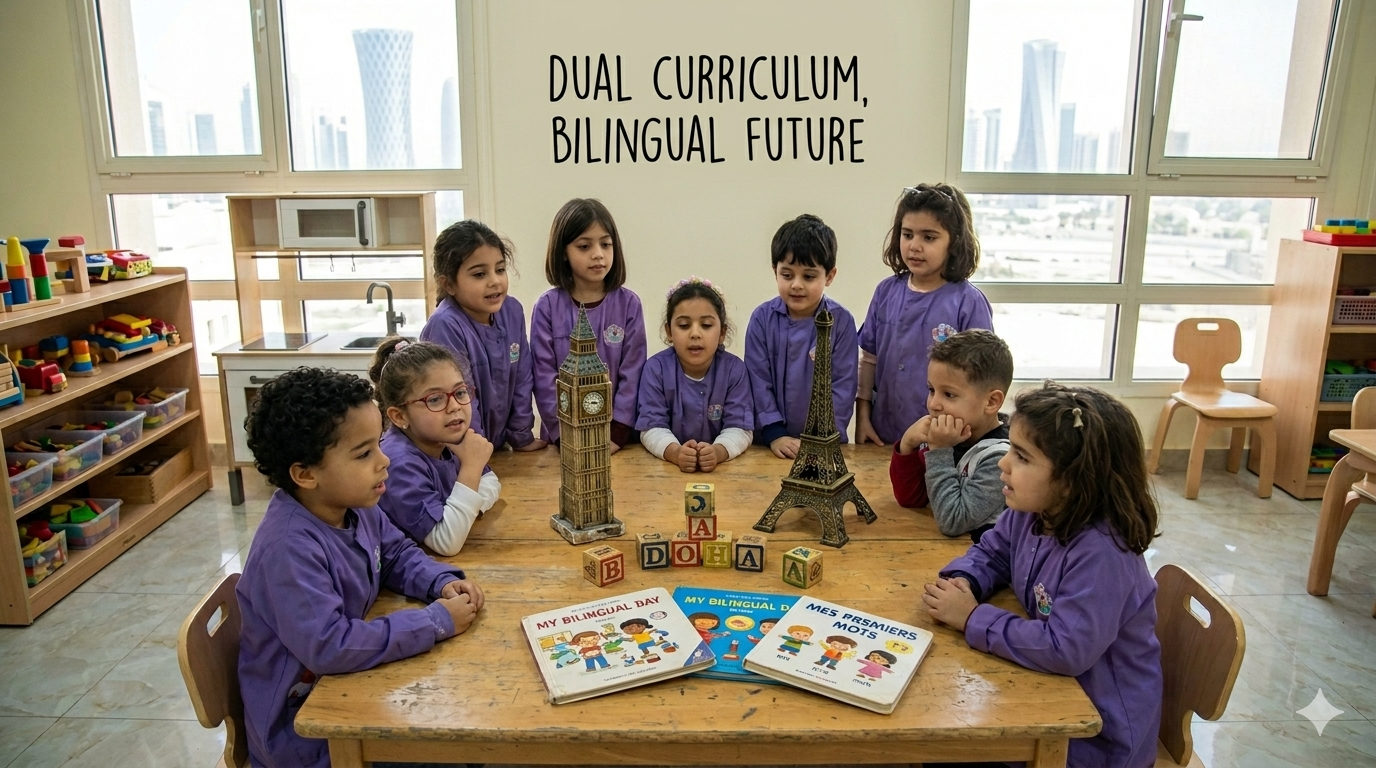
Versailles International Kindergarten is the first institution in Qatar to offer a fully integrated British (EYFS) and French early years curriculum, officially recognised and approved by the Ministry of Education and Higher Education (MoEHE).
What does 'fully integrated' actually mean? It means that the British and French elements are not running as parallel programmes that children switch between. They are woven together into a single, coherent daily experience. Language is used purposefully throughout the day — children hear, speak, and respond in both English and French in context, not in isolation.
Our teachers are trained in both frameworks. They understand not only the content of each curriculum but the philosophy behind it — and how to hold both philosophies in a productive, complementary tension. The structured literacy approach of the EYFS sits alongside the creative, analytical spirit of the French method. The result is something genuinely greater than the sum of its parts.
MoEHE approval is not a formality. It means our programme has been reviewed, assessed, and endorsed by Qatar's educational authorities as meeting the standards required for quality early childhood education in this country. For parents, it provides assurance. For children, it provides a foundation that is recognised and respected.
Life in Al Markhiya — Why Location Matters
The daily reality of a school that fits into your family's life
Choosing a school is not only a philosophical decision. It is a daily logistical reality. Morning drop-offs, afternoon pickups, traffic, proximity to where you live and work — these things matter. A school that is beautiful in principle but impossible in practice adds stress to your family's life rather than removing it.
Versailles International Kindergarten is located in Al Markhiya — one of Doha's most well-connected and family-friendly residential areas. For families looking for the best kindergarten in Al Markhiya, our location offers genuine daily convenience across the city.
- 📍Hazm Al MarkhiyaA short drive, often under 10 minutes — one of our most convenient catchment areas.
- 📍Al Duhail & Al RayyanEasily accessible via well-connected roads with minimal congestion during school hours.
- 📍Al Gharafa & Madinat KhalifaA comfortable 15–20 minute commute through well-maintained routes.
- 📍Lusail & The PearlReachable in 20–25 minutes via Al Khor Expressway — perfectly manageable for families in northern Doha.
Al Markhiya offers a calm, residential atmosphere well-suited to a kindergarten environment. Your child is not navigating a busy commercial district every morning. They are arriving in a neighbourhood that feels safe, unhurried, and human in scale. We have also given careful thought to our physical premises — ensuring drop-off and pickup is smooth, parking is adequate, and the arrival experience is as stress-free as possible.
Making Quality Education Accessible
Flexible payment plans designed around real families in Doha
We understand the financial reality of raising a family in Doha. Many families are managing fees for multiple children, navigating new roles, or balancing fluctuating salaries. That is why we built three clear payment options — without compromising quality.
Maximum flexibility. Fits neatly into your monthly salary cycle with no large upfront commitment.
A balanced approach — fewer transactions than monthly, while keeping cash flow manageable throughout the year.
Best overall value, with priority registration consideration for families choosing the annual plan.
We encourage you to speak with our admissions team directly about your situation. We are human beings talking to human beings — and we will find a way to make this work.
Beyond the Books: A Day in the Life
What your child actually experiences from the moment they walk through our door
Numbers, frameworks, and curricula tell part of the story. But what a child actually experiences from the moment they arrive — that is what truly shapes them. So let us paint you a picture.
Your child is greeted by name — in English or French. The day begins with a gathering of the whole class: sharing news, a morning song in two languages, and hearing the day's plan. It is warm, familiar, and reassuring.
One table: a literacy activity — building words with phonics cards, listening to a short story, illustrating a character. At another: a mathematical challenge with physical objects. In the creative corner: open art with no wrong answers.
Outdoor play at Versailles is not a break from learning — it is learning. Physical activity, social negotiation, imaginative play, and natural exploration are all deeply educational. Our outdoor space is safe, stimulating, and thoughtfully designed.
Songs, a story told by the French-speaking teacher, a game that embeds vocabulary naturally. Children do not feel they are 'switching classes.' They feel that French is simply another part of their world — which, in fact, it is.
A unit on 'Water,' for example, might involve science observation, French vocabulary for ocean creatures, an English picture book about rain, and a painting activity. This integration — ideas connecting across languages — is one of the most powerful aspects of what we do.
At the end of the day, your child comes home having spoken two languages, engaged their body and mind, built relationships with classmates from different backgrounds, and experienced learning as something joyful rather than burdensome. That is what early education should feel like.
How to Register for the 2026 Academic Year
A clear, simple guide — no confusion, no bureaucratic overwhelm
⏰ Early Registration Discount — Limited Seats Available
Families who register and confirm by the early registration deadline are eligible for a meaningful discount on annual fees. We maintain intentionally small class sizes — which means a finite number of places. We do not say this as a pressure tactic. We say it because it is true, and because you deserve accurate information to make your decision wisely.
The Best Start Is the One You Give Them Now
You will not remember every conversation you had in 2026. But your child will carry what happens to them in these years for the rest of their life. The language they hear, the adults they trust, the curiosity they are encouraged to express, the confidence that either does or does not take root — these things shape who they become.
"Choosing a school is an act of love. It is you saying to your child: I have thought carefully about who you are and who you might become — and I have chosen an environment that honours both."
The combined British and French curriculum kindergarten at Versailles International Kindergarten is our answer to the question every thoughtful parent in Doha is asking. It is structured enough to build strong foundations. Creative enough to nurture the whole child. Bilingual in the deepest sense — not as a feature, but as a way of being. And it is located, priced, and managed with the real lives of real families in mind.
We would love to meet you. We would love to meet your child. Come and see what we have built — and imagine what your child might grow into here.
Get in Touch With Us Today
Our admissions team is ready to answer your questions — no waiting, no automated systems.
Versailles International Kindergarten · Al Markhiya, Doha, Qatar · MoEHE Approved · Bilingual Education Doha · School Registration Qatar 2026